Motivation vs Habits

As you may know from previous blogs, I like to read about how others make themselves better and get on with the important things in life. I have taken this on by pushing myself to write a blog every morning. Good or bad, every morning…..

Today, I really did not want to sit down and write. Not because the writing doesn’t tend to flow, but I didn’t feel that I had anything to write about. Because of that, I didn’t feel like I could be bothered to think about something to write about, so I thought, I would leave it for today.

What happens if I do that again tomorrow and the next day? Soon I won’t have a habit of writing every day, so writing every day will be harder and harder to motivate myself to do it. Normally, I try and write about someone and that is always easy. The people I meet are so amazing and have done so many things, it is easy to motivate myself to research and write about them. Today, I wanted to write a more thoughtful piece.


Then TaDa! I thought that writing about motivation would be a good subject. So here it is!

If you haven’t heard about or read Scott Adam’s book How to fail at everything and still win big, I would recommend that you give it a go. He is the man behind Dilbert. It talks about motivation in a way many self-help/business gurus/coaches don’t talk about. It talks about making habits and ticking things off every day. Scott himself talks about how that has made him great at what he does and he talks about how Jerry Seinfeld hones his craft in a similar way. Quick wins and being a success overnight are not the norm for most successful people. They have worked hard at their craft, learned many lessons along the way. Just because you haven’t seen them do it and they jump out in the media all a sudden doesn’t mean they haven’t spent years getting to that point.

You can read the “top 10 what successful people do in the morning”, “6 things successful people never do”, “How Mark Zuckerberg has his breakfast so that he can make millions, so you can too” articles all you like. But if you are not putting the work in, doing all that reading isn’t going to help you. What is going to motivate you to get to where you want to be. Scott Adams recommends, not goals, but plans. I have been working with that concept now for about 2.5 years and I like the way it works. I am one of those that likes to tick things of a list. Marking off the days of a calendar also works for me. I know when I missed and I know that I am not going to beat myself up if I do. But equally, each day, I get better with the habits I am creating. I have a ‘point’ I can focus on. This is my motivation. So today, when I didn’t really want to write anything, forcing myself to just get on with it, so I didn’t miss a day, caused me to write this!

I hope you find something helpful to take away to determine what habits you want to build into your life today.

Hope it is a great one!

Ghilaine

@LadyGhilaine
Is collaboration always productive?

I was at a meeting hosted at co-working space where I was suddenly struck by something. For a set fee a month, you get to use the co-working space in an open plan area. Walking around there, I saw a lot of people staring fixedly at their screens with their headphones on. This didn’t strike me as terribly collaborative or productive.

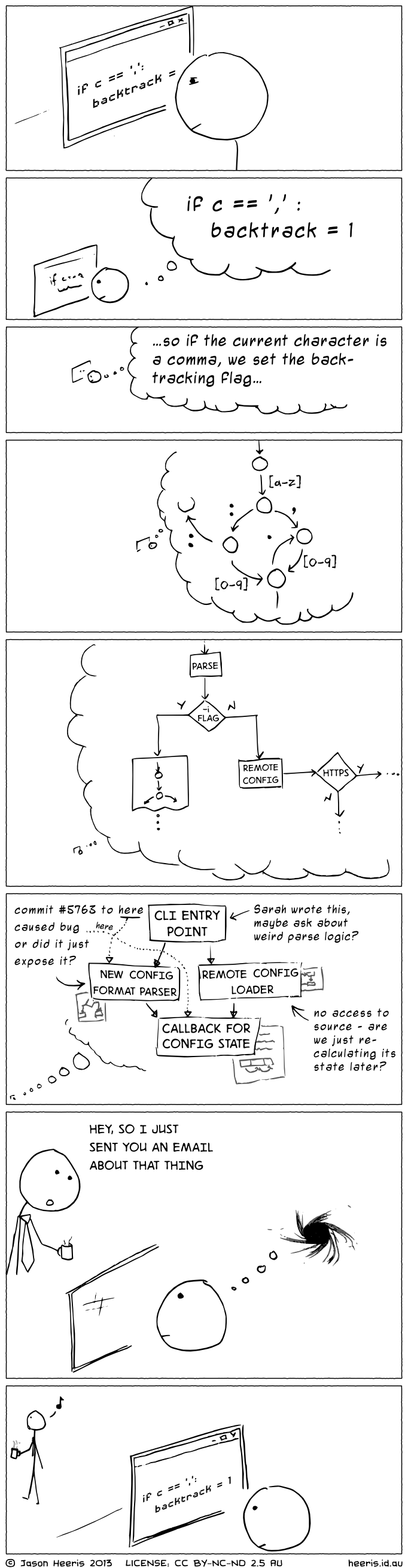
ProgrammerInterruptedDevelopers like to tune everyone else out to focus on the problem at hand. You need to see the code, the more spiritual might even say feel the code, though I feel that’s a bit of the usual fluffy claptrap really. It’s about getting into the zone, and making sure you stay there so that you are productive. Being in an open plan office isn’t really conducive to that. You are constantly being bothered by interruptions; by people moving past your eye line, it’s loud. Thus, you see a lot of people with their headphones on trying to concentrate; this does seem to be completely at odds with what’s intended to be a collaborative space. You aren’t collaborating and you’re not as productive as you would be in a dedicated environment.

If you truly expect your team to be productive; then you have to make the office space fit your team; not some idealised vision of what a office should be. While it might look quite cool in pictures, having bean bags in the office is never a good idea. My entire team is distributed so we all work where we need to work, sometimes that’s in the office, most of the time it’s from home and we communicate over IM and VOIP. When we all choose to be in the office, that’s when we collaborate, I don’t try and force collaboration on the team. Even so, the office area is still very sparse; we just have a couple of big whiteboards on the wall. It’s quiet to the point of silence, but we schedule regular breaks where we collectively go for coffee, and this is when we start the collaboration process; sometimes moving back into the office to use the whiteboards.

When you’re building a product, at some point talking about what the product is has to give way to actually building it. An office space that favours interruptions isn’t going to help you do the work. Sometimes being left alone is what’s needed

Here’s to a productive day

Lewin

@quotidianEnnui

Image link: http://twitpic.com/dj27dh

How do you work out what is important?

I have a very long to do list, that incorporates my work, family and personal chores. Not so amazingly, the stuff I enjoy doing never gets on that list, it just gets done. What a shocker! 😉

Sometimes, what are seemingly mundane tasks get done in a jiffy when I am in the right mood. Mostly, these aren’t always the important tasks, they are the ones that are short and get ticked off easily.

ProductivityI am a very task driven person, so it used to be that if it was on the list and needed to be done, it would get done. More recently, not so much and, I have tried to pin point why.

I have read books and articles that highlight what you can do to increase productivity. Everything from Getting Things Done, to assessing your body rhythm in order to focus the activity to the natural state of your body. Quite honestly, none of it has really helped. I know when I am best suited to do certain tasks, but it doesn’t necessarily mean I will do them. I have just downloaded a productivity podcast series by the get it done guy, let’s see if that works!

I have even given up caffeine and, I fear, it may have been a mistake. My previous team may have seen me manically getting through my list with as few casualties as possible. Those days seem to be gone, I would quite like them back!

On the upside, I am trying to work out if I feel a little healthier that I can now leave things for another day and not be stressed about it. I have learned over my career that some things will always be there, like shifting sand, you dig a hole only for it to have disappeared the next day.

Equally, I don’t like feeling like I have left jobs half done. It makes me feel like I didn’t put enough effort in or done the task correctly.

I have decided that there is one way to ensure the task gets to the top of the list and gets done. What comes first? Those tasks that make a direct impact on the important people around you. This focusses on spending time with family or friends (co-workers, contacts), making their lives easier or better.

Does the next task on your list do that? If not, move on to one that does.

This, you may say is not what you are paid to do. Have you ever discovered what happens when you help a co-worker get their task done? If not, you should try! You may find that your task list gets shorter or easier as a result.

And there you have it, a direct impact on family or friend! Job well done!

Ghilaine

@LadyGhilaine

Being open to new ideas

I once read somewhere that the art of being educated is really 3 things; being able to entertain yourself, being able to entertain others and being open to new ideas. The first two aren’t that interesting in the workplace, but the last one certainly is.

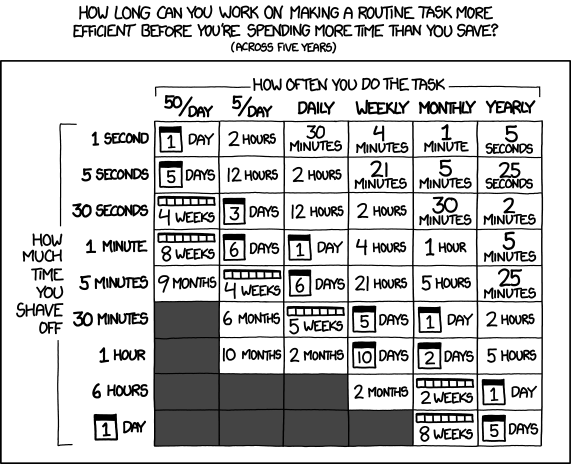
Being open to new ideas is an important attribute, especially in tech. One of the fundamental things that should be on all our to-do lists is to find a better way to do the things that are mundane and routine. You should be looking to automate the boring things and spending time on things that are more interesting.


Getting rid of the boring things will allow you to be more open to new ideas, none of us are in the position where we’re in a state of perfect efficiency so there’s always going to be a better way to do the things. The important things is to recognise when things can be done better; it’s often tempting to think that because you’ve always done something in a certain way, it’s the only way to do things. It’s often better to start again than it is to keep pursuing a dead end, even if you have sunk time and money into the dead-end.

Being open to new ideas isn’t hard; it’s just an acceptance that you aren’t right all the time. In development there is an entrenched idea that certain things are good and always desirable; for instance 100% code coverage, in your tests. But sometimes, it just gives you a false sense of security. You could have 100% code coverage, but if the way in which you’re using the external API is just a bit rubbish, and it would never have worked in production; then your code coverage metric means absolutely nothing because you haven’t met the user requirements.

Get exposed to new ideas, knowing what is a good idea and the basic concepts around which certain “rules” are formulated mean that you know when you can break the rules. Dogmatic adherence to rules means that you get trapped into a certain way of thinking, which will not allow you to be open to new ideas.

Lewin

@QuotidianEnnui