Networking my way through the NHS LDNTech Talk

Last week, we had our first of many LDNTech Talks. The topic more specifically: navigating the NHS landscape and developing key relationships. Being a student from America on a study abroad program, I had all kinds of feelings and nerves rushing through my body beforehand. Do I know enough about the NHS? How do I start a good conversation with someone I don’t know? Do I do this? Do I do that?

Long story short, the night was a huge success. We had three inspiring and knowledgeable event panelists who were able to share their journey with the rest of us; Michael Seres, Mike Buck and Sarah Haywood. We were fortunate enough to have Sarah and Mike with us in person, while Michael was video chatted into the conversation. It’s amazing how far technology has taken us in this day and age. Thank you, Skype!

FullSizeRenderHere’s a bit of insight on how our three speakers got involved with the NHS. After a struggle with Crohns’s Disease, Michael created sensor technology for ostomy patients. He is now trying to get it into the UK health system. Mike oversees BJSS engagements on behalf of the central government of the NHS. He is experienced in all kinds of IT functions and development. Last, but certainly not least, Sarah Haywood. Sarah is chief operating officer of MedCity who had an endless amount of experience and brought with her helpful insight to all guests. I can speak for everyone when I say the three panelists did an incredible job!

After hearing a few inspiring stories and a good question and answer period, it was time to network. I managed to talk with a few very interesting people and get an insight on the system as a whole, as well as personal thoughts and opinions. One thing I picked up on quite quickly – The key to success is creating and developing successful business relationships. It’s all about networking!

In regards to my previously asked questions, I’ve answered them for myself. Just go with the flow. Networking isn’t about going into an event or conversation with every word of every sentence planned out. Rather, it’s about jumping into a conversation with an open mind, letting things flow naturally.

“In today’s world, you have to interact. You can’t be some difficult, shy person who is not able to look someone in the face; you have to present yourself. You have to know how to talk about your vision, your focus, and what you believe in.” Anna Wintour

We hope to see you all at our next LDNTech Talk!

Tori Langhams

@Tlanghans

Motivation vs Habits

As you may know from previous blogs, I like to read about how others make themselves better and get on with the important things in life. I have taken this on by pushing myself to write a blog every morning. Good or bad, every morning…..

Today, I really did not want to sit down and write. Not because the writing doesn’t tend to flow, but I didn’t feel that I had anything to write about. Because of that, I didn’t feel like I could be bothered to think about something to write about, so I thought, I would leave it for today.

What happens if I do that again tomorrow and the next day? Soon I won’t have a habit of writing every day, so writing every day will be harder and harder to motivate myself to do it. Normally, I try and write about someone and that is always easy. The people I meet are so amazing and have done so many things, it is easy to motivate myself to research and write about them. Today, I wanted to write a more thoughtful piece.


Then TaDa! I thought that writing about motivation would be a good subject. So here it is!

If you haven’t heard about or read Scott Adam’s book How to fail at everything and still win big, I would recommend that you give it a go. He is the man behind Dilbert. It talks about motivation in a way many self-help/business gurus/coaches don’t talk about. It talks about making habits and ticking things off every day. Scott himself talks about how that has made him great at what he does and he talks about how Jerry Seinfeld hones his craft in a similar way. Quick wins and being a success overnight are not the norm for most successful people. They have worked hard at their craft, learned many lessons along the way. Just because you haven’t seen them do it and they jump out in the media all a sudden doesn’t mean they haven’t spent years getting to that point.

You can read the “top 10 what successful people do in the morning”, “6 things successful people never do”, “How Mark Zuckerberg has his breakfast so that he can make millions, so you can too” articles all you like. But if you are not putting the work in, doing all that reading isn’t going to help you. What is going to motivate you to get to where you want to be. Scott Adams recommends, not goals, but plans. I have been working with that concept now for about 2.5 years and I like the way it works. I am one of those that likes to tick things of a list. Marking off the days of a calendar also works for me. I know when I missed and I know that I am not going to beat myself up if I do. But equally, each day, I get better with the habits I am creating. I have a ‘point’ I can focus on. This is my motivation. So today, when I didn’t really want to write anything, forcing myself to just get on with it, so I didn’t miss a day, caused me to write this!

I hope you find something helpful to take away to determine what habits you want to build into your life today.

Hope it is a great one!

Ghilaine

@LadyGhilaine

ABC of Networking

I have broken down some networking tips into some easy to remember parts. I hope it helps. I want to follow up with some other handy tips on what to talk about and how best to move around a room, not getting stuck too long in one conversation. I hope you enjoy! abc_network

Ask Questions

Have you ever been stuck with someone who talks about a subject that you are not interested in or they are already deep in conversation with someone already. The best way to start get into conversation is to ask questions. If nothing else, you will learn something. When was the last time you felt good about someone, was it the person who was interested in what you had to say? Ta Da! It was the questions that showed you they were interested.

Be Nice

This sounds a bit silly, but if you dismiss what someone says or tell them they are wrong 2 minutes after you have met them, how do you think they will feel about you after that encounter. A quote I love (which I can’t reference)

“Everyone you meet is fighting a battle you know nothing about. Be kind. Always”

This helps me think about my daily interactions. Life is tough, you are having a bad day, so, maybe, is someone else. What makes you special in this regard? Nothing. Remember that sometimes, just a kind word can change someone’s day and, more importantly, mood.

Concentrate on what they have to say

Or another way to say this, is Listen (but that wouldn’t fit into my alphabet!). Don’t look across the room at other people or see who else is around. Really listen and take in what the person is saying. I tend to write things down and it helps me concentrate on what is being said, but sometimes this may not be appropriate. By going back to asking questions, you can clarify what they are saying and by repeating some of what they have said in your own words means it is more easily retained in the memory. By listening, you can watch their face and see how they feel about the subjects they are talking about. Again, their face then becomes memorable too.

Don’t interrupt

This goes back to being a listener and being nice. Whilst others are talking, many people are thinking about what they are going to say and get so excited, they talk over someone else. We teach our children not to interrupt when adults are talking as they sit there minute after minute waiting for a space. What this teaches them is to wait for someone to take a breath and get started as soon as there is a space. Be more considered with your responses. Wait until there is a gap in conversation. If there isn’t one, perhaps you won’t get to hold court today. But another day, you may get your spotlight. Often the most quiet person is seen as enigmatic, so once you have spoken people may think you are the wisest in the room. Or in my case, maybe not!

Exchange details

This isn’t necessary, but for me, meeting new people should always be about seeing how you can help them, by connecting them to someone else or by passing on a little knowledge that could be useful. If you don’t exchange details, you won’t be able to help them properly and your offers will sound and be empty promises. Some people may not want to pass their details to you, so don’t sweat it if you don’t.

Follow up with them afterwards

I am not sure if there is etiquette on this, but if someone has given me their business card, I think it is only courteous to follow up with a message. This can only be done if you have exchanged details. It allows you to follow up with your offer of help or ask any questions that you may have missed when talking with them. As networking is seen as the most basic form of business development, how can you build a good business relationship if you only contact them out of the blue 2 years after you met? This is where LinkedIn comes into its own. By doing the above, I have managed to have some really interesting conversations with people who know a lot about their specialist subjects. I have learned so much and to me that is the sign of a good day! Hope yours is good too. Ghilaine @LadyGhilaine

Channel 4 ad-break

image001 (1)I love this picture, makes me feel like I am in a Channel 4 ad-break. I had the opportunity of going to the Channel 4 offices last week.

 If you weren’t aware Channel 4 don’t have studios or produce content, they commission all of it. This means that collaboration and partnership are at the heart of its business dealings. This also keeps them on the cutting edge of technology as they are constantly in the ‘marketplace’ of new ideas.


Ghilaine
@LadyGhilaine

Being open to new ideas

I once read somewhere that the art of being educated is really 3 things; being able to entertain yourself, being able to entertain others and being open to new ideas. The first two aren’t that interesting in the workplace, but the last one certainly is.

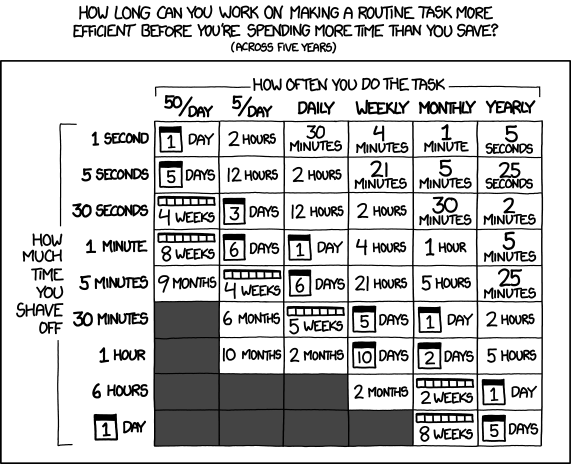
Being open to new ideas is an important attribute, especially in tech. One of the fundamental things that should be on all our to-do lists is to find a better way to do the things that are mundane and routine. You should be looking to automate the boring things and spending time on things that are more interesting.


Getting rid of the boring things will allow you to be more open to new ideas, none of us are in the position where we’re in a state of perfect efficiency so there’s always going to be a better way to do the things. The important things is to recognise when things can be done better; it’s often tempting to think that because you’ve always done something in a certain way, it’s the only way to do things. It’s often better to start again than it is to keep pursuing a dead end, even if you have sunk time and money into the dead-end.

Being open to new ideas isn’t hard; it’s just an acceptance that you aren’t right all the time. In development there is an entrenched idea that certain things are good and always desirable; for instance 100% code coverage, in your tests. But sometimes, it just gives you a false sense of security. You could have 100% code coverage, but if the way in which you’re using the external API is just a bit rubbish, and it would never have worked in production; then your code coverage metric means absolutely nothing because you haven’t met the user requirements.

Get exposed to new ideas, knowing what is a good idea and the basic concepts around which certain “rules” are formulated mean that you know when you can break the rules. Dogmatic adherence to rules means that you get trapped into a certain way of thinking, which will not allow you to be open to new ideas.

Lewin

@QuotidianEnnui